The ECoC evidence base
Forty years of European Capitals of Culture in their own words: what cities promised, what they did, and what the evaluations found.
documents
cities
evaluations
bid books
title years covered
40 documents for “Capacity building of cultural sector”
Clear
Capacity Building Programme Another of our key priorities is capacity building across the cultural sector, both in the city of Bodø and across the county of Nordland.
…Y B U ACCESSIBLE HERITAGE ILDING YEAR OF GROWING 2025 Budweis 2028 is growing robustly, with projects blossoming to ensure we harvest as many cultural fruits as possible by 2028.
ECoC objective: Develop the skills, capacity and governance of the cultural sector ECoC objective: Stimulate partnership and co-operation with other sectors ECoC objective: Improve cultural infrastructure Galway 2020 aimed to build the…
SKILLS AND EXPERIENCE The ECoC process is a major capacity-building accelerator for the cultural and creative sector in our city. In BB there are seven cultural institutions managed by the city, two by the region, and one by the state…
Democratic culture – ensuring a wide range of access and availability in the field of cultural goods and services • Decentralised culture – providing equal opportunity for access to culture everywhere in the city Building the image of the…
METROPOLIS OF CULTURE Who can play along: employees of the cultural sector Why do we play: capacity building, networking With whom do we play: culture institutions from Metropolis GZM and Poland, partner institutions from other ECoC cities…
Residencies for artists with disabilities boost inclusion on an European scale. 42 Cultural and artistic content CAPACITY BUILDING: Kultuurikompass The goal of the capacity building programme Kultuurikompass (Culture Compass) is to…
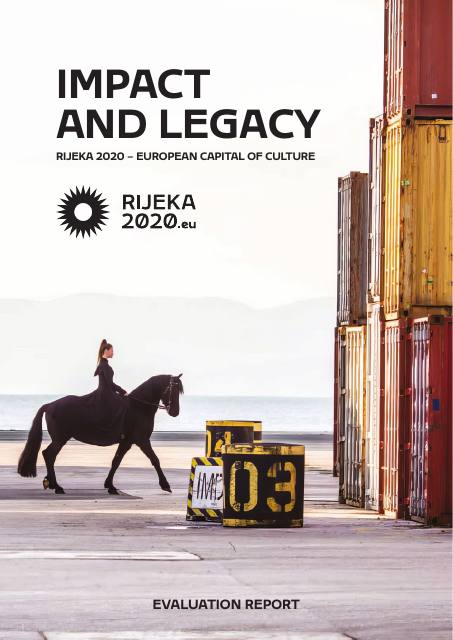
For the implementation of the Rijeka 2020 - European Capital of Culture project, it was crucially important to develop capacities within the cultural sector in order to enable the implementation of a rather comprehensive project, but also…
Those programme strands are Home, Quest and Interface 3) Inviting citizens of Europe to participate and belong Building Capacity Capacity-Building is a key objective for us and our Cultural Strategy.
We have a dynamic cultural life, with a large number of events, yet very few producers have strategies for audience development; the interested people come mainly from the same social segment, and opportunities for cultural education are…
…their ECOC 11 Objectives Type of indicator Indicative indicators Possible sources of data collection Specific objective 3: To strengthen the capacity of the cultural sector and its links with other sectors Result Strategy for long-term…
233), “boost to the cre- ation of cultural infrastructure” (Luxembourg, 1995,capacity building, community empowerment, im- age enhancement, confidence boosting, and rela- p.
Increased skills and professionalism within the cultural sector. 2. Enhanced collaboration between amateurs and professionals. 3. Expanded international partnerships and cultural exchanges. 4.
…of the European Capital of Culture, and the 5-year process of preparing and delivering the proposed programme, will create the setting for the cultural integration of the four cities involved in this effort.
“Bodø2024 was for tourists and the cultural elite, not for us.” Sami Culture Week 2023 | Photo: Fredrik Stenbro | | 7 3 Sami National Day 2023 | Photo: Fredrik Stenbro 74 | | 4.3.
But the kind of society we want cannot succeed on gleaming new buildings alone. STRATEGIC OBJECTIVES To reverse the image of Nordland – internally and externally To widen the production base for culture To connect with groups still not…
Human sustainability will be achieved through massive efforts for capacity building and professionalization of the local cultural sector. Our recently initi- ated Regional Academy for Cultural Managers, the professional forums and…
This is why ECoC will help us attract these industries while building the new creative community and new ecosystem. To one point, this process has already been started with a support of the EU funds through the projects such as COIN Zadar…
…also thanks to the use of specific calls, about 15,000 citizens participating in the implementation of the Cultural programme were above 55 years old.
There is considerable literature and research available for cities to see the range of cultural, urban development and social benefits of an ECoC.

Part of enhancing the cultural experience of the city, is the development of cultural infrastructure. This includes projects that range from the construc- tion of new cycle paths to the restoration of a com- munist building, or the reuse…
Kaunas 2022 will hold an international conference on informal cultural training based on experience and knowledge gained through The Tempo Academy of Culture.
…big events like ECoC create disruptions and it is important to manage them wisely in order to achieve a long-lasting positive impact on the cultural scene that would extend beyond the event as such.
…key projects from the Kultura.PIKA Strategy initiate or participate in EU-projects · work on the climate policy for the cultural sector · develop a cultural network/platform of wider cross- border Istria build on sinergies · take over…
…partners and with each other Key results: • A substantial part of the programme (64 activities, 27.4%) was dedicated to the culture sector, with most activities held in České Budějovice and over half being internal or invitation-based.
LONG-TERM IMPACT: CULTURAL PARTICIPATION AND SOCIAL COHESION 002.1 SOCIOLOGICAL FACTORS : TENSIONS/ATTENTIONS Ensure that at least 70% of the city’s population has the opportunity to attend cultural events.002.2 Number and quality of…
All of these public discussions made us realise, however, that it was crucial to start working on what we identified as problems in Plovdiv’s cultural sector right away, not through discussions, but by offering opportunities to the…
sector (foundations, urban investors etc.) and local Eleusis key actors. In terms of geographical scope, the focus would be mostly on European countries with special emphasis on the Balkan region.
Nonetheless, there were instances of very high quality and overall the cultural programme offered a diversity of activities of many different artistic disciplines.
Structural consultation between the GKO and the social, care and welfare sectors, to increase dialogue between social needs and artistic planning and programming. 6.
To establish long-term exchanges with other cities holding the ECoC title, we not only developed links in the cultural program for the title year 2024, but also long-term and capacity building projects.
For organisations involved in Pécs 2010, capacity-building through the undertaking of “more and bigger projects than in previous years” was felt to have been beneficial for the sector (ECORYS, 2011c: v), as was the sense that these…
According to the panel, the proposed procedures do not fit the capacities of the cultural sector in the city and could therefore have counterproductive outcomes.
…Actions Create intergenerational ICT learning platforms in Create introductory programmes to the culture of Galway for new migrants using cultural institutions.
…if all partner cities have expressed the political support for the ECOC project as the latter has diverse needs and objectives comparing to cultural tourism development, which is politically supported.
Adopt the language of the SDGs One clear challenge for the arts and cultural sector is the need to integrate and adopt the language of the SDGs. There is a need for major institutions to become better at messaging the impact of their work…

Imagine a program serving inspi- ration for spontaneous cultural and social projects launched by citizens, who, under the umbrella of the ECC, will more easily turn their ideas into tangible results that reach audiences.
We will encourage innovation through collab- oration across sectors and industries: music with technology, art of the word with architecture, design and cleantech, performance and transportation, etc.