Encore
Ask the evidenceThe ArchiveAbout Encore
Sign in
Encore by Whitelabel, with Culture NextCities in the network: sign in for your workspace

The ECoC evidence base

The Archive

Forty years of European Capitals of Culture in their own words: what cities promised, what they did, and what the evaluations found.

documents
472

documents

cities
190

cities

evaluations
53

evaluations

bid books
182

bid books

1985–2031

title years covered

All shelvesEvaluations 53Monitoring and progress reports 1Bid books 182Selection and monitoring reports 111EU framework and official documents 27Strategies and action plans 5Research, guides and frameworks 33Shared by cities 1Sent in by members 59Published by cities 12
TypeBid book (pre-selection) 7Bid book (final selection) 12Ex-post evaluation 9Monitoring or progress report 1Strategy 2Action plan 1Research 3Other

12 documents of type bid book (final selection) for “Capacity building of cultural sector”

Clear

Ask Encore: “Capacity building of cultural sector”An answer from across the Archive, every claim cited to its document.

Found inside the documents

  • Dubrovnik 2020 — Final selection
4
Any type
What the document types mean
Bid book (pre-selection)
A city's first application for the title, judged by the selection panel to make the shortlist.
Evidence of intent: what a city promised, not what it delivered.
Bid book (final selection)
A shortlisted city's full, final application for the title, with its programme, budget and plans.
Evidence of intent: what a city promised, not what it delivered.
Selection panel report
The EU expert panel's assessment of the bids in one competition, with its reasons and its recommendation.
Context: useful background, not a city's own evidence of what happened.
Monitoring panel report
The EU expert panel's report on a designated city's preparations before its title year, with its advice.
Context: useful background, not a city's own evidence of what happened.
Ex-post evaluation
An assessment, written after the title year or a programme, of what it actually achieved, usually by independent evaluators.
Evidence of outcome: what actually happened.
Monitoring or progress report
A city's own report on how its programme is going, written while it runs, with the figures it has tracked.
Evidence of outcome: what actually happened.
Strategy
A city's long-term plan or policy for culture, including legacy strategies and council decisions.
A plan: how a city meant to deliver and keep going.
Action plan
A concrete plan of what a city or organisation will do, by when and with what resources.
A plan: how a city meant to deliver and keep going.
Guide or toolkit
Practical how-to material that others can reuse: guides, toolkits, handbooks and templates.
Context: useful background, not a city's own evidence of what happened.
Research
Studies, frameworks and papers across one or more cities, written by researchers rather than by a city.
Context: useful background, not a city's own evidence of what happened.
Other
Anything else: news, memos, programme brochures and documents that fit no type above.
Context: useful background, not a city's own evidence of what happened.
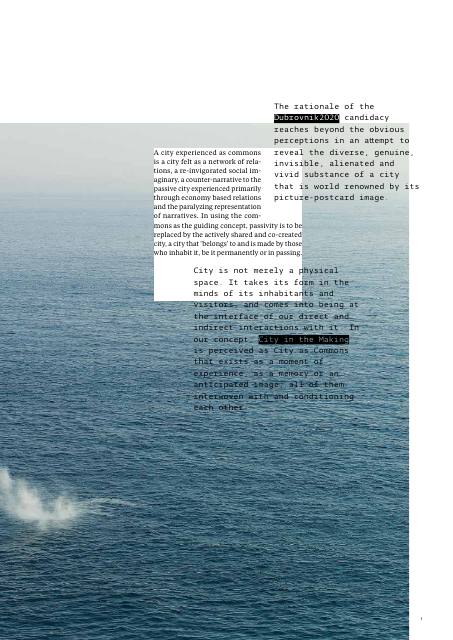
Dubrovnik · 2020
  • Bielsko-Biała 2029
    Bielsko-Biała · 2029

    SKILLS AND EXPERIENCE The ECoC process is a major capacity-building accelerator for the cultural and creative sector in our city. In BB there are seven cultural institutions managed by the city, two by the region, and one by the state…
  • České Budějovice (Budweis) 2028
    České Budějovice (Budweis) · 2028

    …and getting them excited about culture and art. ⚫ Diversifying the levels of engagement of audiences. ⚫ Diversification of audiences for cultural institutions.
  • Debrecen 2023
    Debrecen · 2023

    Democratic culture – ensuring a wide range of access and availability in the field of cultural goods and services • Decentralised culture – providing equal opportunity for access to culture everywhere in the city Building the image of the…
  • Tartu 2024
    Tartu · 2024

    Residencies for artists with disabilities boost inclusion on an European scale. 42 Cultural and artistic content CAPACITY BUILDING: Kultuurikompass The goal of the capacity building programme Kultuurikompass (Culture Compass) is to…
  • Kalamata 2021 — Final selection
    Kalamata · 2021

    Capacity building areas are a.o. cultural management, volunteer management, production, venue operations, funding, logistics, training and vocational education in project management, HR, marketing, communications and fundraising…
  • Bodø 2024
    Bodø · 2024

    Capacity Building Programme Another of our key priorities is capacity building across the cultural sector, both in the city of Bodø and across the county of Nordland.
  • Nürnberg 2025 — Final selection
    Nürnberg · 2025

    The Transformation Think Tank cre- ates tailored capacity development for culutral managers. It conducts international workshops, expert meetings, prototyping modules, in- cubation initiatives, study visits and experimental labs to assess…
  • Hildesheim 2025 — Final selection
    Hildesheim · 2025

    …planning for Hildesheim 2025 brings a longed for appreciation and a positive kind of turmoil that chal- lenges, activates, and empowers the cultural stakeholders.
  • Ljubljana 2025 — Final selection
    Ljubljana · 2025

    We We will establish an Academy of Cultural Management, as Slovenia has so far not systematically provided such training for culture professionals.
  • Namur 2030 — Final selection
    Namur · 2030

    LONG-TERM IMPACT: CULTURAL PARTICIPATION AND SOCIAL COHESION 002.1 SOCIOLOGICAL FACTORS : TENSIONS/ATTENTIONS Ensure that at least 70% of the city’s population has the opportunity to attend cultural events.002.2 Number and quality of…
  • Veliko Tarnovo 2019 — Final selection
    Veliko Tarnovo · 2019

    …and well-being; case stud- ies and reviews on European capital of culture achievements and failures; research and devel- opment of local cultural index, measuring the cultural vitality of the community.